

Yesterday, the American Broadcasting Company sued the F.C.C. in Federal Court. You can read the court filing (“Complaint for Declaratory and Injuctive Relief”) right here, and it’s a pretty good read. “Government censorship is deeply un-American,” it begins, followed by much tub-thumping about Freedom of Speech and the First Amendment.
The crux of the lawsuit: ABC alleges that the FCC is employing its licensing power to censor its broadcasts, and, specifically:
The Commission has demanded a review of the [ABC] Stations’ licenses extraordinarily early. For all but two of the Stations, this early review comes before their current license terms have even reached the halfway point, and years before the Commission is statutorily authorized to grant renewal. That timing underscores the Commission’s true purpose: coercing and retaliating against a network that refuses to bow to the Administration’s demands. (p.3)
The charges in the lawsuit are grounded in ample evidence - I love that ABC’s legal team embedded a truly damning Truth Social post in the filing:
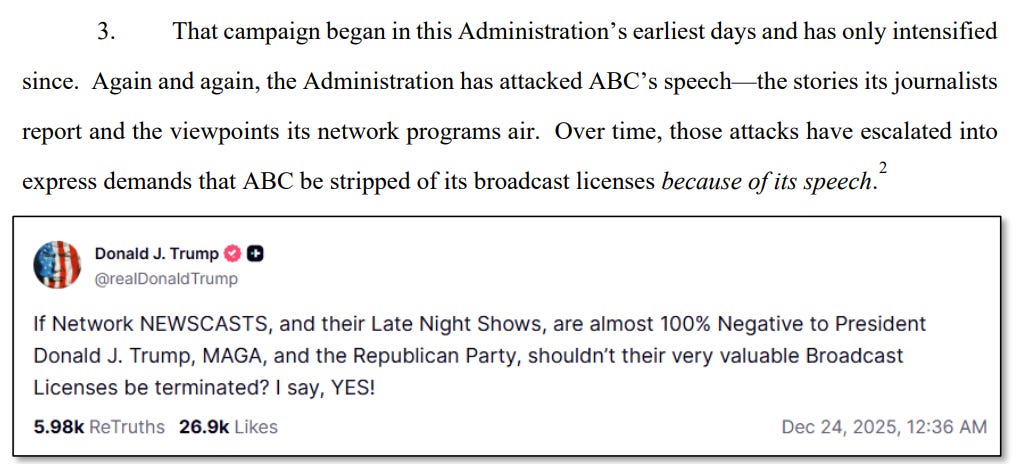
I’m persuaded by the facts described in the ABC lawsuit. I do, in fact, believe the FCC is exploiting its licensing power to influence, and even perhaps censor (through indirect means, see: “chilling effect” described on p.37), the network. I think this is an awful situation, manufactured by the worst FCC Chairman in the regulatory agency’s long history.
But I also think ABC is going to lose this lawsuit.
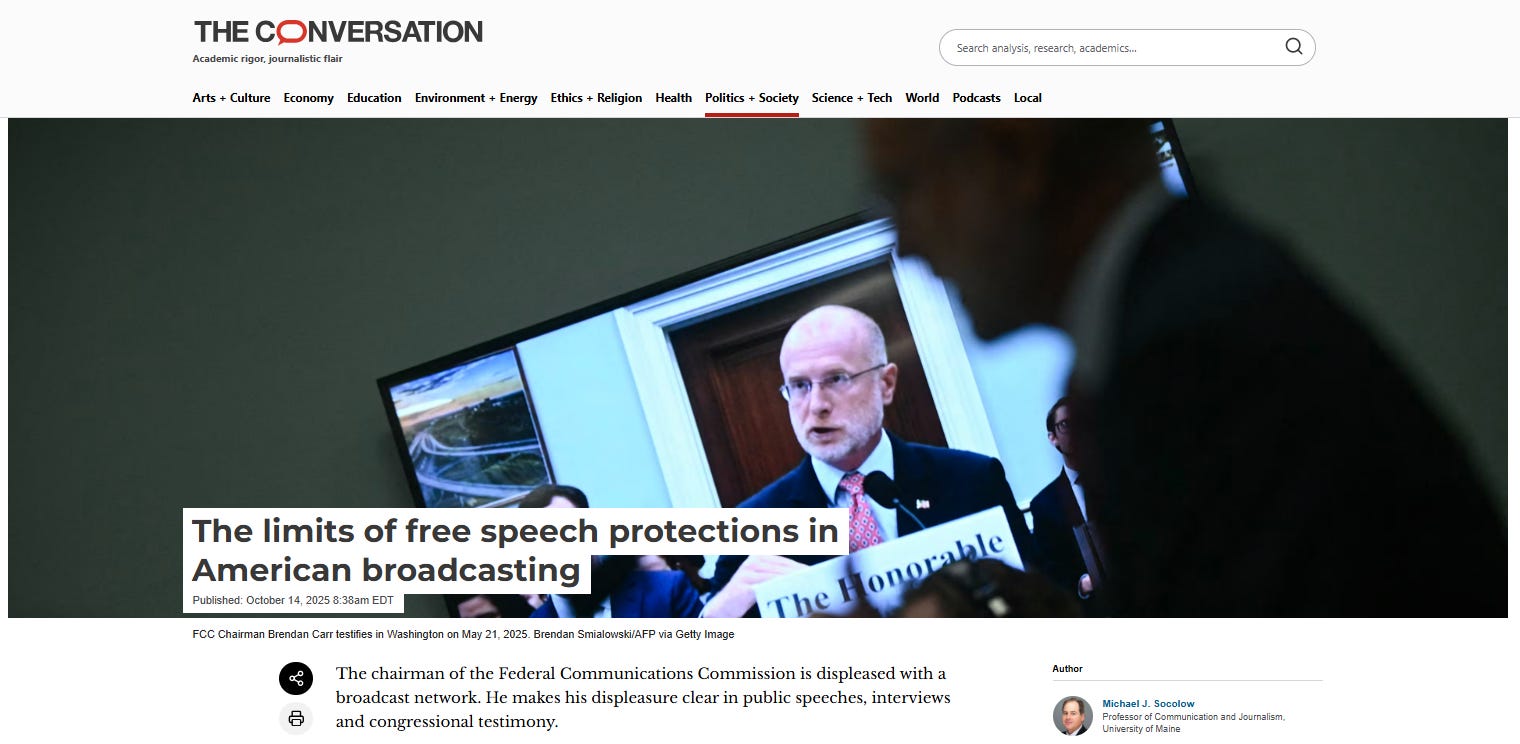
Why? Because there’s no First Amendment in broadcasting, and there hasn’t been since at least 1943. I wrote an explainer for The Conversation on the limits of Free Speech in broadcasting last year that covers this ground pretty thoroughly.
The key case remains National Broadcasting Company, et. al. v. United States, et. al. 319 U.S. 190 (1943). This decision fundamentally cemented the FCC’s expansive powers over U.S. broadcasting. I was on a panel recently with Professor Thomas W. Hazlett, and Hazlett, a former Chief Economist of the FCC, excoriated the Supreme Court for its faulty reasoning in NBC v. US. I agree with Hazlett (who’s written excellent scholarship on the FCC) that the NBC decision was faulty in many ways. But what nobody can deny is that the Supreme Court’s 1943 ruling shaped everything that followed - from the creation of ABC by the forced divestiture of NBC’s second (“Blue”) network, to Newton Minow’s “Vast Wasteland” speech, to Janet Jackson’s “wardrobe malfunction,” to Brendan Carr’s potshots at Jimmy Kimmel. Without NBC v. U.S. (1943), FCC Chairs wouldn’t feel so emboldened.
Plenty of cases upheld NBC v. US in the decades since. For example, in Federal Communications Commission v. Pacifica Foundation (1978), the FCC’s speech-based rules on indecency were upheld, despite an appeal based upon the (supposed) First Amendment rights of broadcasters. My basic thinking about ABC’s lawsuit can be summed up in these 2 tweets I posted to X yesterday:


I don’t think ABC can win on the idea that the FCC is being retaliatory or chilling speech. But I do think they have a (slim) chance if they can prove the punitive regulatory action (the early license reviews) was capricious, or based on imprecise legal reasoning, or too-vague accusations. That slim chance hinges on how Carr’s FCC legal team worded its original demands. And I don’t think even Carr’s FCC legal team is that dumb (though it’s possible).
Here, specifically, is the FCC’s justification of the punitive order:
While none of Disney’s ABC licenses would ordinarily be due for renewal until 2028, at the earliest, the FCC is permitted under section 73.3539 of its rules to call for the early renewal of licenses when the agency determines that doing so is essential to the proper conduct of an investigation. As stated in the Early Renewal Order, “the FCC has been investigating Disney’s ABC stations for possible violations of the Communications Act of 1934 and the FCC’s rules, including the agency’s prohibition on unlawful discrimination.” Specifically, the FCC has been investigating whether Disney’s ABC engaged in prohibited practices by hiring, promoting, compensating, and/or providing workplace opportunities to people based on race, gender, or other protected characteristics in violation of federal nondiscrimination laws. In the course of conducting that investigation, the FCC determined that calling in Disney’s ABC licenses for early renewal was necessary to the proper conduct of that ongoing investigation. [citations deleted, original here].
The FCC’s going after Disney ostensibly for violations of the Communications Act of 1934, but also for supposedly violating federal nondiscrimination laws. That’s an expansive investigation, delving into ABC actions far beyond Jimmy Kimmel’s jokes. As Stalin’s secret police chief once (apocryphically) said: “Show me the man and I'll show you the crime.” Carr’s version? “Show me the broadcaster, and I’ll show you the violation.” I find the FCC’s actions here pretextural and even somewhat arbitrary. No matter how this whole sorry episode began, it now involves a fishing expedition in ABC’s Human Resources files.
There’s a reason the influential political scientist Murray Edelman’s The Symbolic Use of Politics (1964) was based upon his earlier close examinations of the F.C.C. Edelman discovered, by analyzing the Federal Radio Commission’s and Federal Communications Commission’s exercises of licensing power, that much communications regulation proved performative. The FCC invokes processes resembling symbolic rituals designed to obscure actual sources of political power and authority from the American people. “According to Edelman, political reality is concealed from the public through the generation of largely empty symbols by the political elite,” notes the Encyclopedia Britannica. The American regulatory system, under Edelman’s formulation, transforms supremely political questions into (phony) apolitical and “objective” rulings. It’s a form of mystification. In this sense, FCC Chair Carr’s partisan advocacy and blatant hypocrisy could charitably be viewed as refreshing honesty (read what Carr wrote in Project 2025 for a sense of just how much he’s violating his professed values. Or see this recent Politico interview). Though I find Carr’s leadership a dangerous disaster, I won’t go as far as Reason’s Nick Gillespie, who recently called for the abolishment of the FCC.
I was thinking of Edelman’s scholarship in relation to Carr’s FCC because I wondered: Who’s demanding the ABC network be harrassed and censored right now? I doubt it’s the American public. ABC’s David Muir is the most-popular person on the U.S. airwaves.
Ultimately, any FCC action is legislatively predicated on service to the American public, “in the public interest.” But Howard Stern, at the turn of the century, exposed this fiction. He rallied his radio listeners to inundate the FCC with complaints about his broadcast rivals. He conjured into existence an American public demanding FCC enforcement.

Yet Stern’s “imagined community” was completely ignored. To the FCC, apparently, some broadcast audiences are more equal than others.
I don’t think censorship constitutes a popular policy proposition in the United States. That’s one key reason why ABC filed its lawsuit. I think, at this moment, the person who most wants to see ABC muzzled and neutered isn’t Brendan Carr. It’s Donald Trump. Carr’s performing for an audience of one. Yet Donald Trump’s popularity is cascading to new depths, which undoubtedly emboldened the network to counterpunch with the censorship accusation.
I still think ABC is going to (eventually) lose, because the current Supreme Court isn’t going to overturn NBC v. US. But I also think that as long as the lawsuit remains alive through the appeals process, and the framing of FCC censorship as draconian overreach persists, ABC will win in the court of public opinion.
That’s ultimately why ABC’s lawsuit is a valuable civic service in the public interest.
What about this language in the decision?
"... Congress did not authorize the Commission to choose among applicants upon the basis of their political, economic or social views, or upon any other capricious basis. If it did, or if the Commission by these Regulations proposed a choice among applicants upon some such basis, the issue before us would be wholly different."